




Chandigarh, September 21
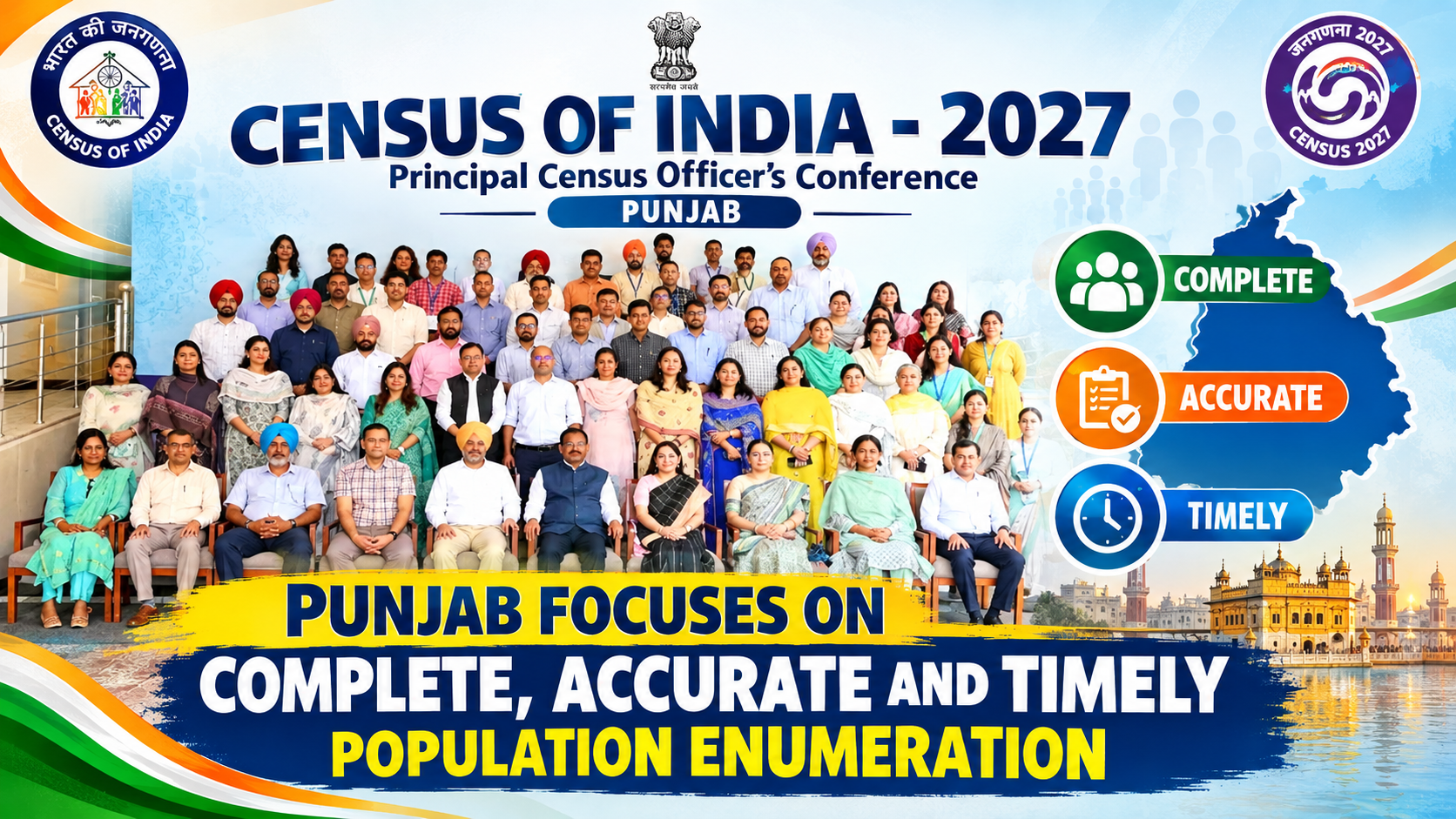
A one-day conference of Principal Census Officers (PCOs) for Phase-II of Census 2027—Population Enumeration—was held at Hotel Mount View, Chandigarh, under the chairmanship of KAP Sinha, Chief Secretary, Punjab, to review preparedness and operational readiness for the upcoming Population Enumeration phase.
The conference was attended by members of the State Level Census Coordination Committee (SLCCC), Divisional Commissioners and all Principal Census Officers, including Deputy Commissioners of the districts and Municipal Commissioners of Municipal Corporations.
At the outset, Dr. Navjot Khosa, Director, Census Operations, Punjab, welcomed the Chief Secretary, members of the SLCCC, Divisional Commissioners and Principal Census Officers.
The conference provided a detailed overview of the major components of Phase-II of Census 2027, including Population Enumeration preparedness, finalisation of Enumeration Blocks (EBs), human resource planning, training and deployment, the Population Enumeration questionnaire, digital tools, self-enumeration, media and publicity, field-level preparedness and administrative responsibilities.
Detailed presentations were also made on the operational and technical aspects of the exercise to ensure its coordinated, timely and accurate implementation within the prescribed timelines.
Chief Secretary Emphasises Census as a National Exercise
Addressing the participants, Chief Secretary KAP Sinha said that the Census is one of the most significant national exercises undertaken by the country and serves as an important foundation for demographic and socio-economic information used for governance, planning, policy formulation and delivery of public services.
He stressed that the successful conduct of the Census requires meticulous administrative preparedness, commitment, coordination, ownership and a strong sense of responsibility at every level. He urged all Principal Census Officers to accord the exercise the highest priority and discharge their responsibilities with dedication and accountability.
The Chief Secretary emphasised that every stage of the Census process must be carefully planned, closely supervised and completed within the prescribed timelines. He underlined the importance of seamless coordination among district administrations, municipal bodies and concerned departments to ensure complete coverage and maintain the accuracy, quality and credibility of the Census.
He also called upon the PCOs to provide effective leadership to the field machinery and ensure that all Census functionaries are adequately trained and fully aware of their roles, responsibilities and prescribed guidelines.
Highlighting Punjab’s role in Census 2027, he urged all PCOs to personally monitor preparedness and execution in their respective jurisdictions and ensure that the exercise is conducted with the highest standards of dedication, accuracy, completeness and responsibility.
State Nodal Officer Stresses Adherence to Guidelines and Timelines
The State Nodal Officer briefed participants on the administrative and coordination framework for Phase-II and stressed strict adherence to Census guidelines, prescribed procedures and timelines at every stage.
The PCOs were advised to begin close and continuous monitoring from the preparatory stage, including finalisation of Enumeration Blocks and human resources, training, deployment of field functionaries and field execution.
They were also advised to establish effective review and monitoring mechanisms at the district and charge levels, with continuous supervision and timely resolution of operational issues.
Special emphasis was placed on inter-departmental coordination and regular assessment of preparedness so that gaps could be identified and addressed well before field operations begin.
Director Census Operations Reviews Phase-II Preparedness
Dr. Navjot Khosa, Director, Census Operations, Punjab, briefed the participants on the schedule and major operational requirements for Phase-II of Census 2027. The Population Enumeration questionnaire containing 40 questions on various parameters was also discussed in detail.
Timeline for Phase-II – Population Enumeration
- Self-Enumeration: November 16, 2026 to November 30, 2026
- Phase-II: December 1, 2026 to January 4, 2027
- Revisional Round: January 5, 2027 to January 9, 2027
- Reference Date: 00:00 hours of January 5, 2027
Dr. Khosa also made a detailed presentation covering the formation of Enumeration Blocks, human resource planning and rationalisation, training cascade, self-enumeration, digital tools, budget, media and publicity.
She highlighted the importance of coordinated planning, timely execution, effective use of technology and strong field-level preparedness for the successful conduct of Population Enumeration.
Dr. Khosa said effective leadership, close supervision and meticulous preparation would be key pillars for the successful implementation of the Population Enumeration phase. She highlighted the critical role of PCOs as the principal district-level authorities in translating Census guidelines into coordinated and timely field-level action.
She stressed the timely completion of preparatory activities, particularly finalisation of Enumeration Blocks, human resource planning and deployment of Census functionaries. Adequate and appropriately trained personnel must be available well in advance for smooth field operations, she added.
The Director also highlighted the importance of the training cascade, including timely completion of Field Training, to ensure that all functionaries are familiar with their roles, responsibilities, procedures and digital tools before deployment.
She further emphasised robust monitoring mechanisms and close supervision at every level, along with effective use of digital tools for timely reporting, monitoring and resolution of operational issues.
Special Focus on Difficult and Inaccessible Areas
Special emphasis was placed on ensuring complete coverage of inaccessible, difficult and vulnerable areas. Dr. Khosa urged the PCOs to identify such areas in advance and make appropriate field and supervisory arrangements to ensure comprehensive coverage and proper documentation.
She also highlighted the importance of public awareness and effective publicity regarding Self-Enumeration. Coordinated efforts at the district and field levels were called for to sensitise citizens about the Census process, encourage participation and facilitate effective use of the Self-Enumeration facility.
The PCOs were also briefed on their responsibilities regarding timely finalisation of Census functionaries, training arrangements, field preparedness, inter-departmental coordination, monitoring of field operations, publicity of Self-Enumeration and resolution of operational issues at the district and charge levels.
Way Forward
The conference concluded with a detailed discussion on the way forward, with emphasis on complete coverage without omission or duplication, coordinated and time-bound action, and accountability among all stakeholders for the successful implementation of Phase-II of Census 2027 in Punjab.
The Chief Secretary reiterated the importance of collective ownership, close coordination and continuous monitoring by all concerned departments and field-level functionaries.
He called upon all Principal Census Officers to personally lead and closely supervise preparations in their respective jurisdictions and ensure that every stage of the Census is carried out with dedication, responsibility, accuracy and completeness.
The conference reaffirmed the collective commitment of all stakeholders towards the smooth, timely, accurate and comprehensive conduct of Phase-II of Census 2027 in Punjab.