




CHANDIGARH, September 28
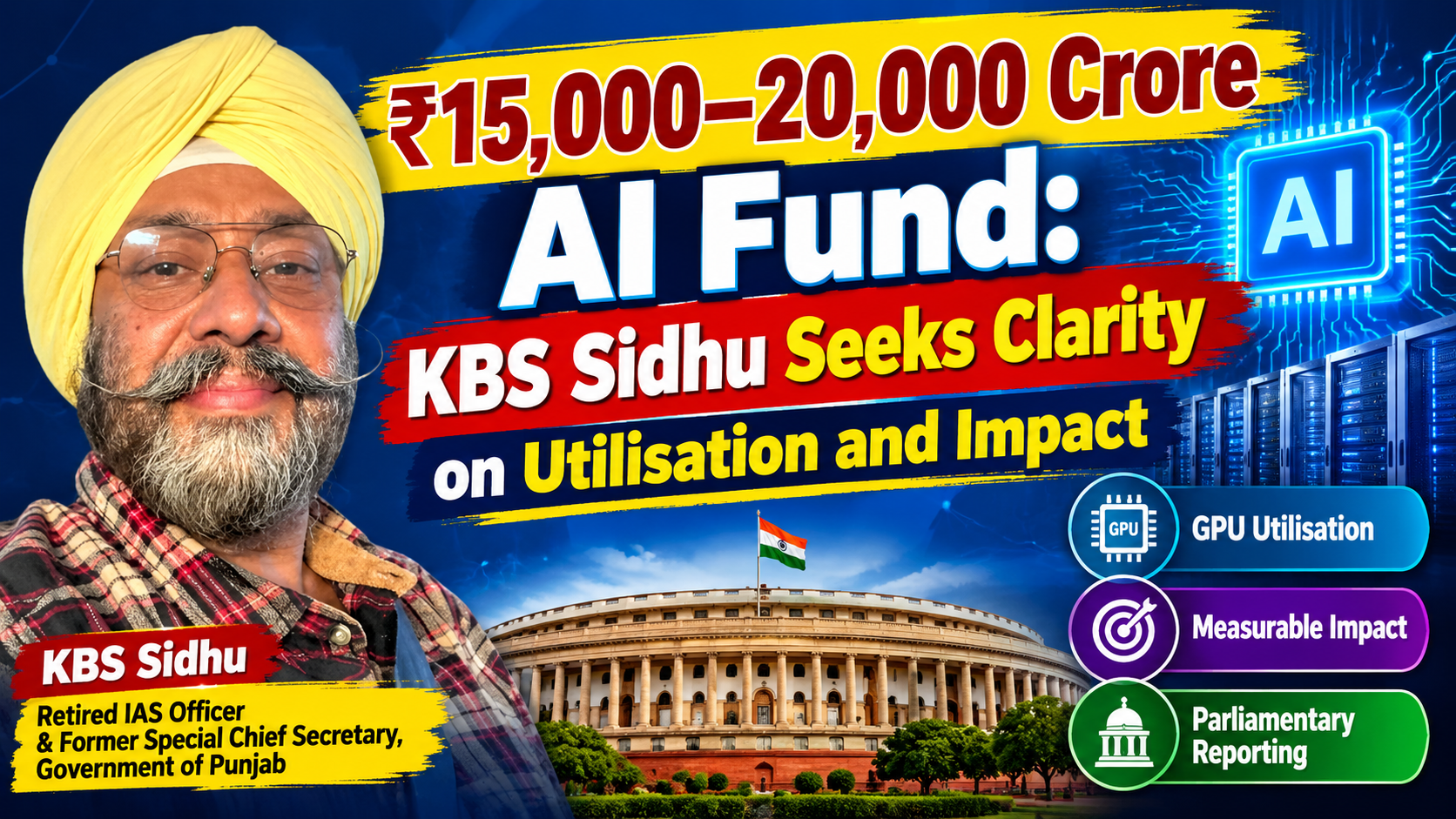
The proposed National Frontier AI & Compute Fund should be subject to annual reporting to Parliament on what it builds, who uses the infrastructure and models it supports, and what measurable impact it delivers, said KBS Sidhu, retired IAS officer and former Special Chief Secretary, Government of Punjab.
In a letter sent today to Union Minister for Electronics and Information Technology Ashwini Vaishnaw, Sidhu also called for the Government to publish data on the utilisation of India’s existing AI compute capacity before committing additional public funds.
The proposed Fund, reported by ETGovernment on September 26, is expected to see the Government anchor ₹15,000–20,000 crore to provide long-term capital support to Indian foundation-model developers, GPU clusters and specialised data centres. The proposed allocation is nearly twice the ₹10,371.92 crore original five-year outlay of the IndiaAI Mission. The proposal is currently under consultation with AI companies and investors.
Sidhu welcomed the initiative, stating that it, along with ISM 2.0 and the 50 per cent fiscal support for semiconductor fabrication and packaging units, could strengthen India’s efforts towards sovereign AI capabilities. He also appreciated the Ministry’s decision to consult stakeholders before finalising the Fund’s structure.
watch…..Private Passport Agent Held Red-Handed Accepting ₹20,000 Bribe in Jalandhar
However, he stressed that AI infrastructure requires built-in performance measurement because GPU technology can remain at the frontier for only three or four years, while AI models can be overtaken within months.
Sidhu has urged the Minister to seek answers from the Secretary and technical officials of the Ministry of Electronics and Information Technology (MeitY) on six key areas:
- Utilisation: How many GPU-hours has the common compute facility delivered against its total capacity, and who has used it? According to the figure cited for August 2026, 93.18 lakh GPU-hours were delivered across 237 projects, against more than 45,000 GPUs onboarded. Sidhu has suggested that utilisation data should be published quarterly before additional capacity is financed.
- Focus: Which layers of the AI stack and which sectors will the Fund support, and which areas will be excluded, to prevent resources from being spread too thinly across chips, frontier models, data centres and applications?
- Terms: What will the Government secure in return for public capital, including data residency, access for public institutions to funded models, technology-transfer conditions, and safeguards separating MeitY’s role as an investor from its role in framing AI regulations?
- Milestones: What output, outcome and impact indicators will be reported to Parliament annually? Will funding tranches be linked to milestones, with an independent review after five years?
- Oversight: Will the AI Safety Institute have adequate compute resources and evaluators to assess models supported by the Fund? Sidhu has also sought clarity on the timeline for establishing a statutory framework for AI.
- Sequencing: How will the Fund be coordinated with ISM 2.0, domestic chip packaging, power-grid availability and data-centre locations to ensure that the initiative does not increase India’s dependence on imports?
“The first phase of the IndiaAI Mission bought GPUs; the second proposes to buy companies. Neither, by itself, has yet bought India a capability it controls,” Sidhu said. He added that every rupee invested through the proposed Fund should be able to answer three questions: what it built, who used it, and what difference it made.
KBS Sidhu is a 1984-batch IAS officer of the Punjab cadre who retired in 2021 as Special Chief Secretary, Government of Punjab. He served as Principal Secretary (Finance), Punjab, from 2010 to 2012. A Gold Medallist in Electronics and Telecommunication Engineering from Thapar Institute, Patiala, in 1983, he has written extensively on sovereign AI as Founder-Editor of The KBS Chronicle.
Sidhu stated that he wrote the letter to the Union Minister in his personal capacity.