

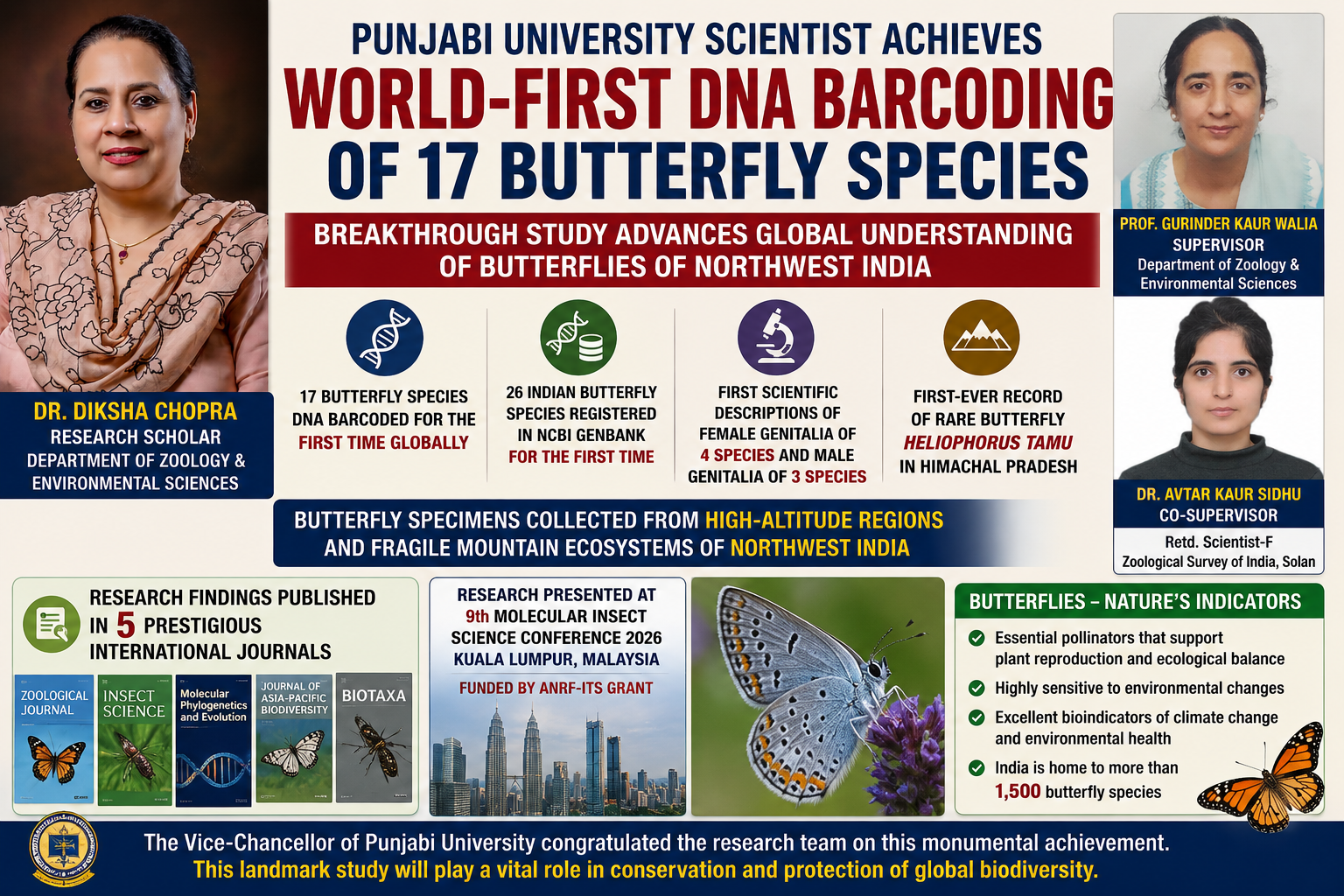

• Research findings published in five prestigious international journals
Patiala, May 31
A pioneering research study conducted at Punjabi University has significantly enhanced scientific understanding of butterfly diversity in Northwest India. The study achieved a major milestone by carrying out DNA barcoding of several butterfly species for the first time anywhere in the world.
The research was undertaken by Dr. Diksha Chopra from the Department of Zoology and Environmental Sciences under the supervision of Prof. Gurinder Kaur Walia and co-supervision of Dr. Avtar Kaur Sidhu, retired Scientist-F from the Zoological Survey of India, Solan.
Dr. Diksha Chopra said that butterfly specimens were collected from high-altitude regions and ecologically sensitive mountain habitats across various northwestern states of India. The study focused on 30 butterfly species, including 24 species from the Theclinae subfamily and six species from the Lycaeninae subfamily.
She added that the significant findings of the research have been published in five renowned international scientific journals. The work was also presented at several national and international scientific forums, including the 9th Molecular Insect Science Conference 2026 held in Kuala Lumpur, Malaysia. The presentation was supported through an ANRF-ITS grant and received widespread appreciation from researchers and experts.
watch……Health Minister Advocates for Cultural Language Ties
Explaining the methodology, Prof. Gurinder Kaur Walia said that the research combined traditional morphological studies with advanced DNA barcoding techniques using the mitochondrial COI gene to resolve complex taxonomic questions.
The study resulted in DNA barcoding of 17 butterfly species for the first time globally, while 26 butterfly species from India were added to the international NCBI GenBank database for the first time. Researchers also documented the female genital structures of four species and male genital structures of three species for the first time in scientific literature.
One of the most notable discoveries was the first-ever confirmed record of the rare butterfly species Heliophorus tamu in Himachal Pradesh, highlighting the need for focused conservation efforts in the region.
Emphasizing the ecological importance of butterflies, Dr. Avtar Kaur Sidhu noted that butterflies play a crucial role as pollinators, supporting plant reproduction and ecosystem stability. Due to their sensitivity to environmental changes, they also serve as valuable bioindicators for monitoring climate change and environmental health. India is home to more than 1,500 butterfly species, making such studies particularly important.
Congratulating the research team, the Vice-Chancellor of Punjabi University described the study as a landmark achievement that will contribute significantly to future biodiversity conservation, environmental research, and wildlife protection initiatives.