

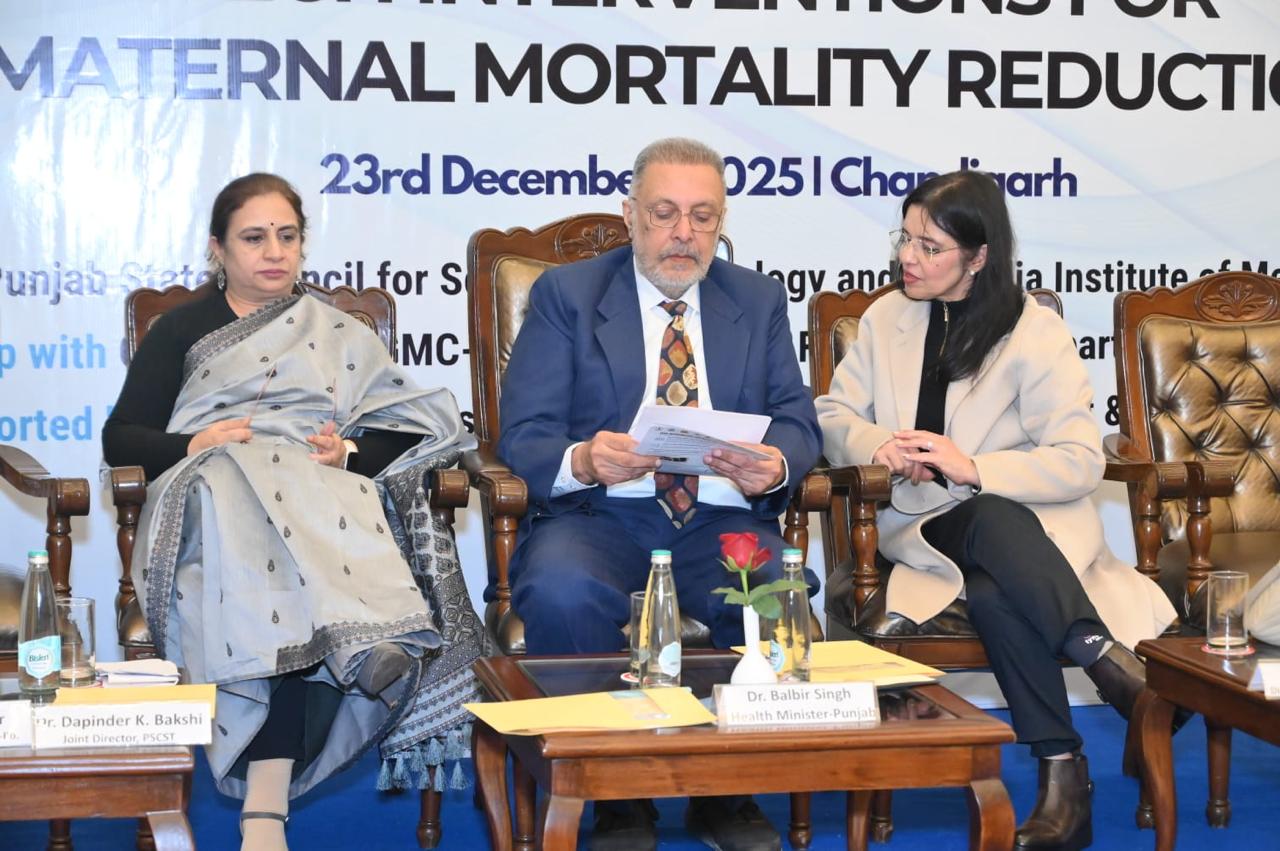

— Health Minister Dr. Balbir Singh speaks at state-level workshop on ‘Tech Interventions for Maternal Mortality Reduction’
— Announces statewide rollout of life-saving interventions to curb maternal deaths
Chandigarh, December 24
In a major initiative to strengthen women’s healthcare, in line with the vision of Chief Minister Bhagwant Singh Mann, Punjab’s Health and Family Welfare Minister Dr. Balbir Singh announced on Tuesday the statewide expansion of proven technology-based interventions in government health facilities to lower the state’s Maternal Mortality Rate (MMR).
Speaking at a state-level workshop titled ‘Tech Interventions for Maternal Mortality Reduction’—organized under Mission Tandrust Punjab with support from the Directorate of Environment & Climate Change—Dr. Balbir Singh stated that the state will implement every effective technological solution to prevent maternal deaths, especially those due to post-partum haemorrhage (PPH). Punjab’s current MMR stands at 95 per 100,000 live births, slightly above the national average of 88.
watch…..Heart Health: A Success Story from Rajindra Hospital
“I urge all medical officers to adopt the best clinical practices so that Punjab can meet the Sustainable Development Goal target of reducing MMR to 70,” said Dr. Balbir Singh. He emphasized the need for collaboration between healthcare professionals and program officers, and stressed prioritizing early nutritional guidance and health monitoring for pregnant women.
The workshop was organized by the Punjab State Council for Science and Technology (PSCST) in collaboration with AIIMS Bathinda and the Department of Health and Family Welfare, Punjab, in Chandigarh.
Er. Pritpal Singh, Executive Director of PSCST, noted that the pilot rollout of Non-Pneumatic Anti-Shock Garments (NASG) and Uterine Balloon Tamponade (UBT) at delivery points in 12 districts during Phases I and II has saved over 300 mothers from critical PPH cases, highlighting the urgency of scaling these interventions statewide.
Dr. Aditi Salaria, Director of Health Services (Family Welfare), Punjab, underscored the importance of early identification of danger signs, standardized referral protocols, and timely interventions. She called on healthcare professionals—particularly gynaecologists and Auxiliary Nurse Midwives (ANMs)—to advance this initiative with focused efforts.
Project leaders Dr. Lajya Devi Goyal, Dean of Research at AIIMS Bathinda, and Dr. Dapinder Kaur Bakshi, Joint Director at PSCST, shared insights on district-level implementation, the availability of life-saving devices at delivery points, and hands-on training for healthcare workers, which have significantly reduced maternal complications.
During the workshop, Dr. Parneet Kaur, Professor at GMC Patiala, and Dr. Parveen Rajora, Professor at GMC Faridkot, presented their experiences on clinical outcomes and field-level challenges in their districts. Experts also conducted hands-on training on NASG and UBT for attending health professionals.
Other notable attendees included Dr. Jaswinder Singh, Civil Surgeon (Patiala), and Dr. Harpreet Kaur, Assistant Director (Department of Health and Family Welfare). The event saw participation from doctors, gynaecologists, nurses, and health officials representing all 23 districts of Punjab.