




Mohali, October 25
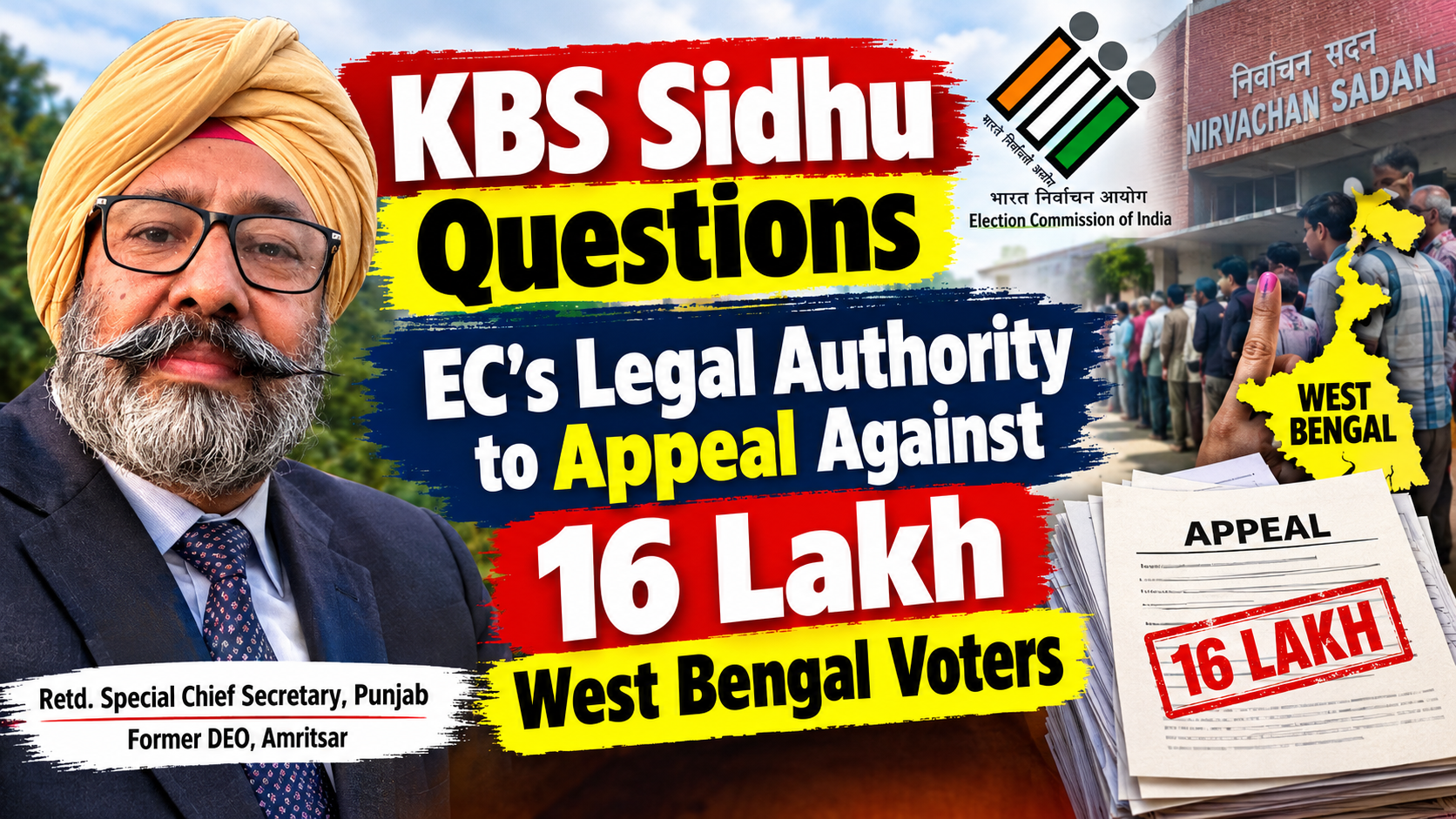
The Election Commission of India’s reported filing of nearly 16 lakh appeals against voters in West Bengal who were cleared by judicial officers appointed by the Supreme Court has no clear basis in election law, according to KBS Sidhu, retired Special Chief Secretary to the Government of Punjab and former District Election Officer, Amritsar.
Sidhu has written to Chief Election Commissioner Gyanesh Kumar, seeking a public clarification on the legal grounds for these appeals and the process through which they were filed.
According to published reports, which Sidhu has clarified he has not independently verified, the Election Commission reportedly appealed against nearly half of the 32.7 lakh voters found eligible by judicial officers during the Special Intensive Revision (SIR) of electoral rolls. More than 12 lakh of these appeals were reportedly recorded with a single filing timestamp of April 5, 2026—just two days before the electoral rolls were frozen for the Assembly elections.
Sidhu has pointed out that the Registration of Electors Rules, 1960, permit an enrolled elector of a constituency to object to another person’s inclusion in the electoral roll. The rules also provide for an appeal by a person who has been heard by the Electoral Registration Officer.
He argued that the Election Commission’s administrative machinery prepares electoral rolls after conducting the required due diligence under the law and its own executive instructions, including those governing the contentious SIR exercise. If an error is identified, it must be corrected through the prescribed legal procedure, either at the instance of an elector or by the Electoral Registration Officer after issuing due notice.
“Having prepared the roll, the Commission cannot arrogate to itself the powers of an objector, least of all in the absence of any statutory provision,” Sidhu said.
Six Questions Raised with the Election Commission
In his letter to the Chief Election Commissioner, Sidhu has sought public answers to six questions:
- Legal authority: Under which provision of law or order of the Supreme Court did the Election Commission acquire the right to appeal against voters cleared by judicial officers?
- Authorisation: Who signed the appeals, and was the Additional Chief Electoral Officer authorised in writing to file them?
- Grounds of appeal: Does each appeal contain an individual, reasoned justification, or were the grounds generated in bulk?
- Filing process: Were approximately 12 lakh appeals uploaded on a single day? If so, who prepared and reviewed them?
- Constituency-wise pattern: What explains the reported appeal rates of 40 to 60 per cent across 222 of West Bengal’s 294 constituencies?
- Comparison with citizen objections: How does the Commission reconcile the reported volume of appeals with its own limit of ten objections per individual citizen?
Sidhu has requested that the Election Commission place its answers in the public domain rather than communicating them exclusively to him. He has also stated that if no public clarification is issued within a week, his letter should be treated as an application under the Right to Information Act, 2005.
Sidhu Emphasises Constitutional Right to Vote
Sidhu has consistently argued in national print and electronic media that Article 326 of the Constitution must remain central to the debate surrounding the Special Intensive Revision of electoral rolls.
Article 326 provides for elections to the Lok Sabha and State Legislative Assemblies on the basis of adult suffrage, subject to the constitutional and legal conditions governing voter eligibility and disqualification. The relevant legal framework also provides for ordinary residence as a criterion for electoral registration, including provisions that can accommodate homeless persons.
“The franchise is the rule; disqualification is the narrow exception,” Sidhu said, reiterating his position that the right to vote should be protected in accordance with constitutional principles and the law.
KBS Sidhu’s Administrative and Election Experience
KBS Sidhu is a 1984-batch IAS officer of the Punjab cadre. During his career, he served as District Election Officer, Amritsar, and as an Election Commission observer in three consecutive Lok Sabha elections.
Drawing on his administrative and election-related experience, Sidhu has called for transparency regarding the reported appeals and the legal authority under which they were filed.
The Election Commission’s response to the questions raised in his letter would help clarify the legal basis, authorisation and procedural details of the reported appeals.