




-Central Government Agrees to Shift Border Fencing Following CM Bhagwant Singh Mann’s Demand
-In the Coming Days, Punjab’s Farmers Will Be Able to Cultivate Thousands of Acres of Border Land Without Restrictions
-Union Home Minister Informed During Meeting That Fencing Will Be Shifted Towards the Border from Punjab’s Land
-Farmers Earlier Faced Severe Hardship While Cultivating Land Across the Fence
-Farmers Had to Cross the Fence with Identity Cards & Under BSF Escort to Farm Their Own Land
-Along the 532 km India-Pakistan Border, Fencing is Located Deep Inside Punjab’s Territory
New Delhi, 17 January
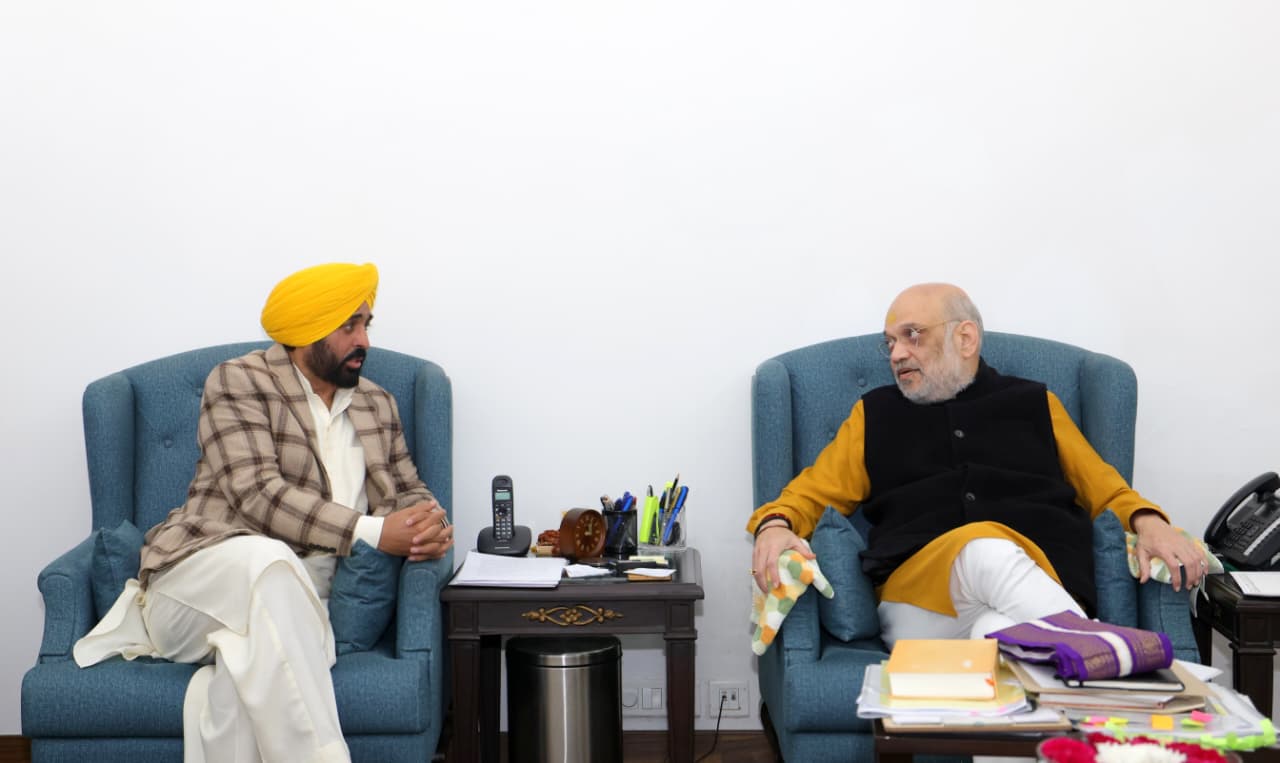
Punjab Chief Minister Bhagwant Mann on Saturday announced a major relief for farmers in the state’s border areas after the Central Government agreed in principle to shift the Border Security Fence closer to the International Border. This decision will enable unhindered cultivation of thousands of acres of farmland that are currently located beyond the existing fencing.
During his meeting with Union Home Minister Amit Shah in New Delhi, the Chief Minister highlighted that farmers have long been compelled to cross the fence daily with identity cards and under the escort of the Border Security Force (BSF) to access their own fields. He pointed out that along the 532 km India-Pakistan border, the fencing is positioned deep inside Punjab’s territory, causing daily hardship and uncertainty for border farmers. The Home Minister informed him that the matter is under active consideration and that the fencing will be realigned towards the border, restoring access to Punjab’s land without compromising national security.
In addition to the border fencing issue, CM Bhagwant Singh Mann raised several long-pending concerns of Punjab, including:
- Strong objections to the proposed Seeds Bill 2025
- The unresolved Sutlej-Yamuna Link (SYL) canal dispute
- Slow movement of foodgrains by the Food Corporation of India (FCI)
- Freezing of Arthia Commission
- Non-payment of Rural Development Fund (RDF) and Mandi Fund
- Dilution of Punjab’s role in the administration of Chandigarh
He sought prompt and time-bound resolution of these issues.
On the Seeds Bill 2025: The Chief Minister strongly objected, stating that Punjab — being an agrarian state and one of the country’s largest grain producers — is not adequately represented in the proposed Bill. The new zone-based system does not guarantee Punjab’s representation in the Central Seed Committee, unlike the existing framework. He added that the Bill curtails the powers of the State Seed Committee, provides no role for it in seed registration, and lacks a robust compensation mechanism for farmers if registered seeds fail to perform. He also raised concerns over allowing imported seed varieties from foreign countries without mandatory multi-location testing under Punjab’s specific agro-climatic conditions. The CM emphasized that forcing farmers to depend entirely on companies for seeds is neither practical nor in their interest. He urged that the Bill should not be tabled in Parliament in its current form. The Union Home Minister assured him that these concerns would be examined.
On River Waters (SYL Canal): Reiterating Punjab’s firm stand, the Chief Minister said Punjab has no surplus water to share. There has been a significant decline in the availability of waters from the Sutlej, Ravi, and Beas rivers. Out of the total 34.34 MAF (Million Acre Feet) of water from these rivers, Punjab was allocated only 14.22 MAF (about 40%), while the remaining 60% went to Haryana, Delhi, and Rajasthan — states through which these rivers do not even flow. He described this as gross injustice and asserted that construction of the SYL canal is neither viable nor in Punjab’s interest. Punjab’s position before the Supreme Court remains unchanged: there is no water to spare.
On Foodgrain Movement & Storage: The CM highlighted that for the past five months, FCI has been moving only 4–5 lakh metric tonnes (LMT) of wheat and 5–6 LMT of rice from Punjab monthly. Against 95 LMT of pending rice from Kharif Marketing Season (KMS) 2025-26, only 20 LMT of storage space is currently available. To ensure timely delivery of custom-milled rice for KMS 2025-26 and space for wheat procurement in Rabi Marketing Season (RMS) 2026-27 starting April 1, 2026, a minimum monthly movement of 20 LMT (10 LMT each of wheat and rice) is essential. He also demanded special trains to clear stocks, noting Punjab’s contribution of around 125 LMT of wheat to the national pool and the need for proper storage for national food security.
watch….CM Mann’s Vision for Enhanced Trade with BC
On Arthia Commission: The commission has remained frozen since the 2019-20 procurement season, contrary to the Punjab Agriculture Produce and Marketing Act 1961. It is currently capped at ₹46 per quintal for wheat and ₹45.88 per quintal for paddy. The commission at silos has been reduced to half of regular mandi rates. A committee formed in January 2024 to revise the rates has not yet decided. The CM stressed that arthias provide essential services and deserve fair remuneration. Delay in revision could disrupt procurement, and rates should be finalized soon.
On Non-Payment of Statutory Dues: Despite statutory provisions, RDF has not been reimbursed to Punjab since KMS 2021-22, even after amendments to comply with Government of India instructions. A total of ₹9,030.91 crore of RDF and ₹2,267.83 crore of Market Fees are pending, severely affecting rural infrastructure like roads and mandis. The CM described RDF as Punjab’s rightful share, not charity, and demanded its release. The Home Minister assured a priority meeting to consider the first instalment.
On Chandigarh Administration: The CM stressed the need to maintain the long-standing 60:40 ratio of Punjab and Haryana officers in Chandigarh. He expressed concern over exclusion of IAS/PCS officers from key posts and opening of departments like Excise, Education, Finance, and Health to other cadres, which dilutes Punjab’s role. The Home Minister assured that the existing ratio would be maintained.
On FCI Punjab General Manager: He urged appointment of a Punjab cadre officer as General Manager, FCI Punjab, citing their expertise in procurement, mandis, storage, and movement. Historically, regular appointments have been from Punjab cadre, with others holding only temporary charge.
On Border Fencing Issue: Along the 532 km India-Pakistan border, fencing is often located 2–3 km inside Punjab’s territory, instead of beyond 150 meters from the Zero Line as per international norms. Thousands of acres of farmland lie beyond the fence, forcing farmers to undergo daily identity checks and BSF escort. Realignment closer to the border would bring large tracts of land to the accessible side, allowing free cultivation without daily restrictions or fear, while safeguarding national security. The Home Minister informed that the issue is under active consideration and similar realignment has already been implemented in Pathankot.
This announcement brings hope and relief to thousands of border farmers in Punjab who have endured years of hardship due to the misplaced fencing.