




Chandigarh/Patiala, September 16
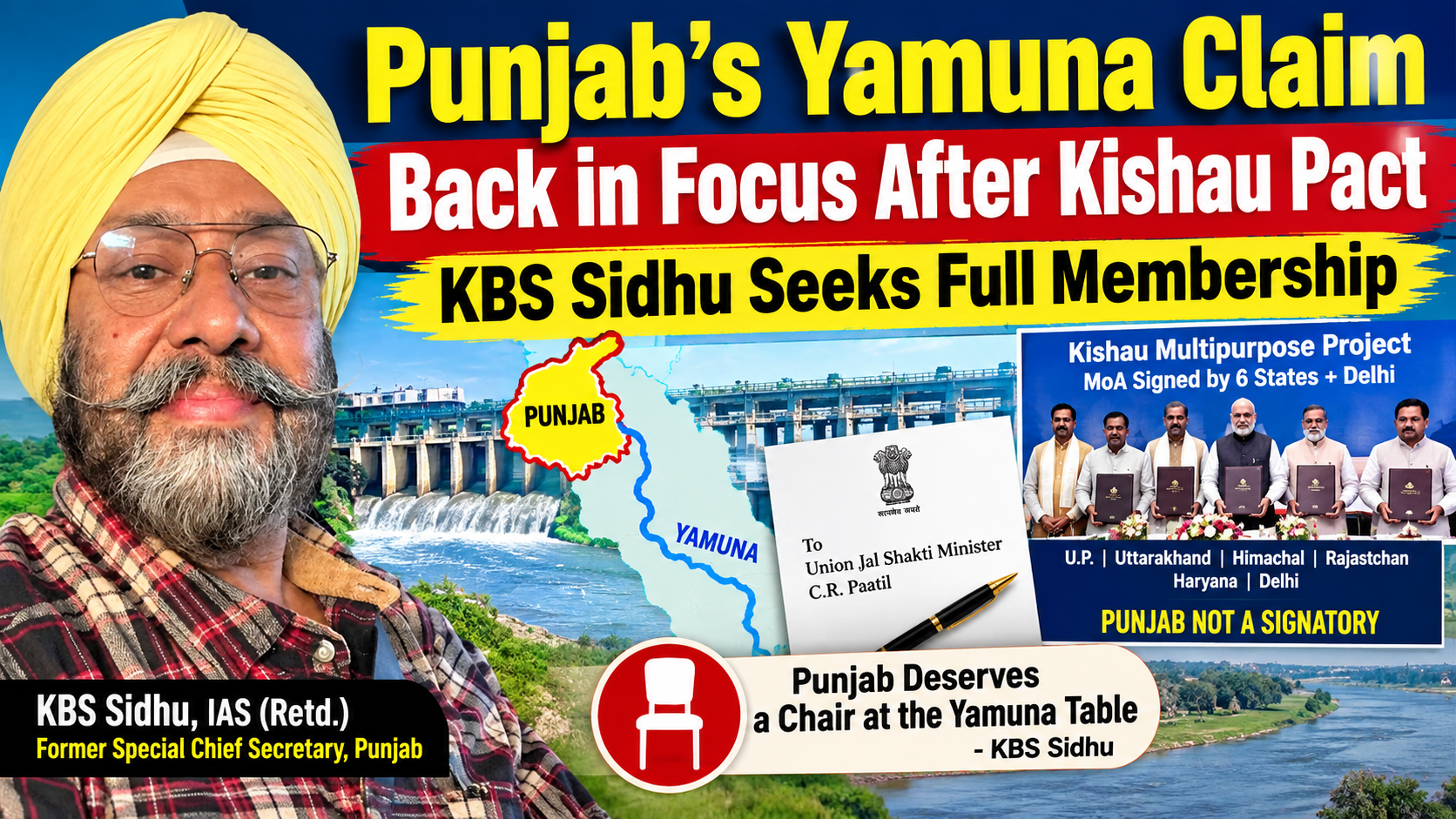
Former Special Chief Secretary of Punjab and former Principal Secretary, Irrigation, KBS Sidhu, IAS (Retd.), has urged Union Jal Shakti Minister C.R. Paatil to include Punjab as a full member of the Upper Yamuna River Board before the Kishau Multipurpose Project proposal is placed before the Union Cabinet.
Writing to the Union Minister in his capacity as a private citizen, Sidhu objected to Punjab’s exclusion from the six-State Kishau Multipurpose Project Memorandum of Agreement (MoA) signed in New Delhi on September 15. He argued that Punjab has once again been left without a seat, a hearing or even a mention in decisions concerning the Yamuna basin.
“This is not about cusecs or million acre-feet. It is about Punjab’s inalienable right to a chair at the Yamuna table, and not merely a share of its waters,” Sidhu said.
The MoA was signed by the Chief Ministers of Uttar Pradesh, Uttarakhand, Himachal Pradesh, Rajasthan, Haryana and Delhi in the presence of Union Home Minister Amit Shah and Union Jal Shakti Minister C.R. Paatil. The Centre has declared the Kishau project a national project and will bear 90 per cent of the cost of its water component. Punjab, however, was neither a signatory to the agreement nor consulted, according to Sidhu.
watch…..Punjab GST Crackdown: 170 Vehicles Detained, Goods Worth ₹5 Crore Seized
Punjab’s Yamuna Claim
Sidhu pointed to what he described as a longstanding inconsistency in the treatment of Punjab and Haryana’s river-water claims.
He noted that Haryana continues to draw Ravi-Beas waters, arguing that its territory was part of undivided Punjab before the reorganisation of Punjab on November 1, 1966.
According to Sidhu, the same principle should apply to Punjab’s historical association with the Yamuna basin. He pointed to the Jagadhri-Yamunanagar belt of the former Ambala district, which, he said, bordered the Yamuna when Punjab was undivided.
“If Haryana carried its Ravi-Beas claim across 1966, Punjab carried its Yamuna standing across the same date, under the same Act,” Sidhu said, adding that the principle should not be applied selectively.
‘Punjab Does Not Oppose Drinking Water’
Sidhu clarified that Punjab’s position should not be interpreted as opposition to drinking-water supplies for other States.
“Punjab does not grudge Delhi or Rajasthan a single glass of drinking water from Kishau,” he said.
He also cited Punjab’s earlier no-objection to Haryana’s Kaushalya Dam project on the Ghaggar, which supplies drinking water to Panchkula, as an example of Punjab’s willingness to cooperate on water-related issues.
“Punjab has shown it is not unreasonable. What it will not accept is being left outside the room every time the basin’s water is decided,” he said.
Three Demands Before Cabinet Approval
Sidhu has made three specific requests to the Union Government:
- The Union Cabinet note should clearly record Punjab’s exclusion from the Kishau agreement and explain the basis for that exclusion.
- Punjab should be admitted as a full member of the Upper Yamuna River Board.
- Punjab should be given an opportunity to present its case whenever the 1994 Yamuna water allocations are reviewed.
Copies of the letter have also been sent to the Union Home Minister, Chief Secretary of Punjab, Secretary of the Department of Water Resources, Chairman of the Central Water Commission and Member Secretary of the Upper Yamuna River Board.
In his communication to the Punjab Chief Secretary, Sidhu has requested that the State Government consider making a formal representation on the matter.
Concern Over ‘Silence’ in Punjab
Sidhu also expressed concern over what he described as the lack of public response in Punjab following the signing of the Kishau MoA.
He said that, so far, no political party, pressure group or activist organisation had publicly raised the issue, and questioned the silence of those who frequently speak about Punjab’s river-water rights.
‘Centre’s Decision Will Set a Precedent’
Sidhu argued that the Centre’s position on Punjab’s place in the Yamuna basin could have broader implications for inter-State river-water claims.
According to him, if a successor State retains its standing in a river basin that it historically shared before the 1966 reorganisation, then Punjab should have a place on the Upper Yamuna River Board. Conversely, if only present-day geographical boundaries are considered, he argues that questions could arise over Haryana’s continuing claims concerning the Ravi-Beas system.
He said the issue could become particularly significant in light of India’s decision to keep the Indus Waters Treaty in abeyance, arguing that future diversion of waters from the western rivers into the Ravi-Beas network could further underline the importance of the principle involved.
“Whichever way the Centre answers, it sets a precedent for Punjab,” Sidhu said. “Either Punjab gets its chair on the Yamuna, or Haryana loses its claim on the Ravi and the Beas.”