



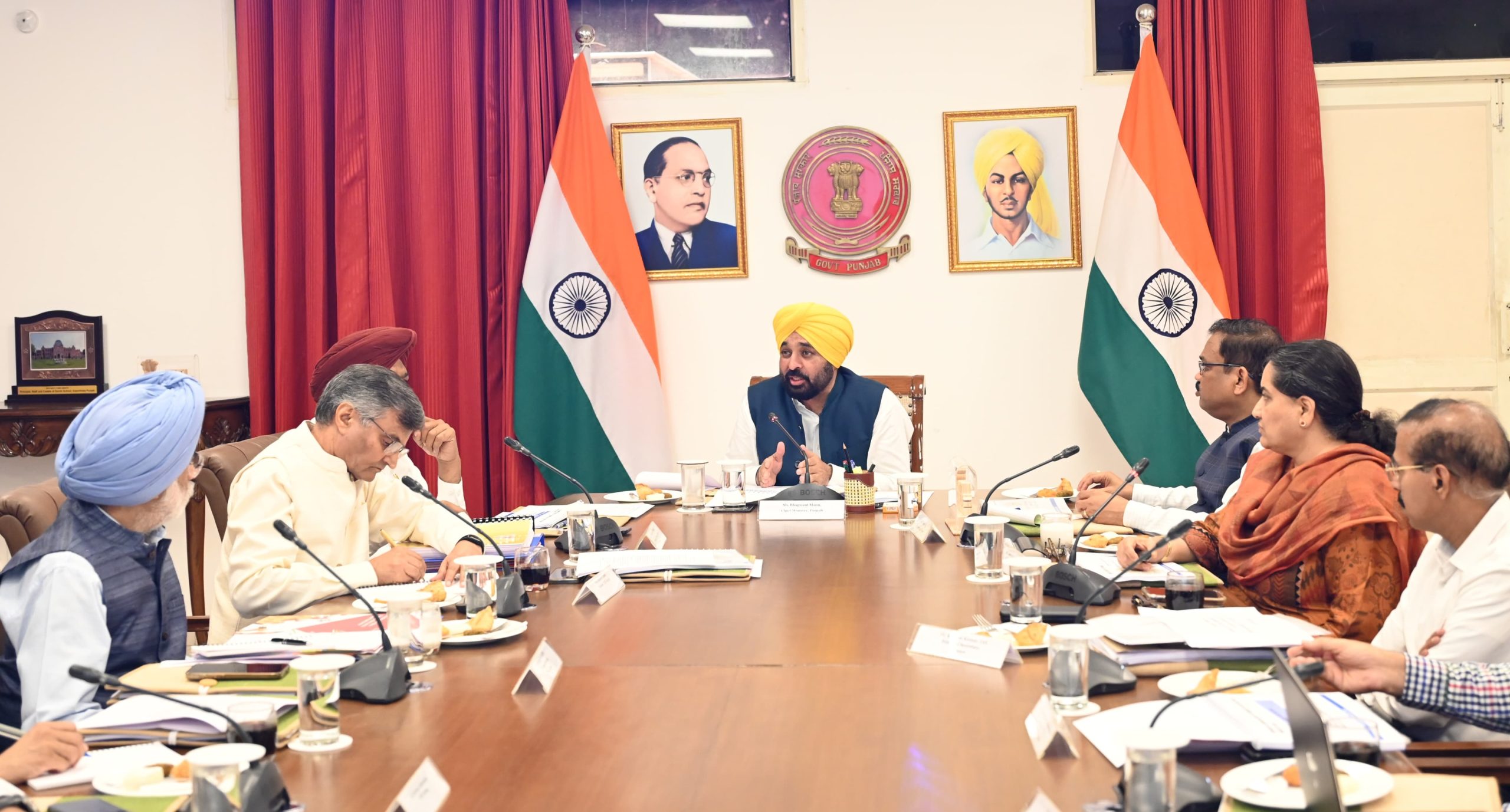

Chandigarh, June 26
Punjab Chief Minister Bhagwant Singh Mann met with a high-level NITI Aayog team, led by Member Prof. Ramesh Chand and Program Director Sanjeet Singh, to advocate for Punjab’s comprehensive development and safeguard its interests. Mann presented a robust case, seeking support in preserving the state’s rich agricultural and water legacy, special incentives for border districts, and enhanced infrastructure to curb cross-border smuggling.
Key Demands
1. Preserving Water and Agricultural Legacy
Mann urged NITI Aayog to support Punjab in maintaining its agricultural prominence and water resources, critical to the state’s identity as a food bowl of India. He highlighted Punjab’s production of 12% of India’s rice and 2% of the world’s rice, emphasizing the need for sustainable practices like crop diversification to conserve water.
- Crop Diversification: Mann sought central government support for Punjab’s pilot project in six districts during Kharif 2025, promoting Kharif Maize with a cash incentive of ₹17,500 per hectare. He requested funds under the Crop Diversification Programme to extend this incentive to all maize growers.
- Cotton Cultivation: To encourage cotton (a water-saving crop) over paddy, Mann proposed developing and commercializing pink bollworm-resistant seed technology, providing assistance for Mating Disruption Technology (MDT), and installing 20 additional AI-based pheromone traps for early pest detection. He also called for subsidized cotton seeds and mechanization support to reduce labor costs, which account for 14% of cotton’s production value.
- Water Rights: Mann reiterated Punjab’s claim to Yamuna waters under the 1954 Yamuna-Sutlej-Link (YSL) agreement, noting that Punjab was entitled to two-thirds of Yamuna waters before its reorganization. He proposed constructing the YSL canal instead of the Satluj Yamuna Link (SYL) canal, as Punjab’s rivers (Ravi, Beas, Sutlej) are in deficit. He also demanded Punjab’s inclusion in negotiations for Yamuna water allocation, citing the 1972 Irrigation Commission report classifying Punjab within the Yamuna River Basin.
- Indus Water Share: Mann asserted Punjab’s right to Indus River water, emphasizing its role in meeting national food demands and the need for irrigation water to sustain agriculture.
watch…….After Small Fish, Now It’s the Turn of Drug Trade ‘Generals’: CM Mann 2. Special Incentives for Border Districts
With 553 km of international border with Pakistan across six districts (Amritsar, Tarn Taran, Gurdaspur, Pathankot, Ferozepur, Fazilka), Mann highlighted the economic challenges faced by these areas due to special incentives provided to Himachal Pradesh, Uttarakhand, and Jammu & Kashmir. He proposed:
- A special incentive package for Punjab’s border districts to boost trade and industry.
- Establishment of Agro Food Processing Zones in each border district, focusing on Basmati rice and horticultural produce like litchi.
- Upgradation of existing Focal Points and creation of an Exhibition-cum-Convention Centre in Amritsar.
- Production-Linked Incentive (PLI) schemes for the agro sector, tax benefits for textiles, freight subsidies, and subsidized interest rates for term loans and working capital in border districts.
3. Compensation for Border Land
Mann demanded an increase in compensation for farmers with land (over 17,000 acres) between the international border and the border fence, from ₹10,000 per acre annually to ₹30,000 per acre, fully funded by the central government. He emphasized the role of these farmers in ensuring national food security.
4. Strengthening Border Security
To counter smuggling of drugs and weapons via drones, Mann sought ₹2,829 crore for infrastructure and equipment upgrades, including jammers, as over 80% of the border lacks jamming systems, posing a threat to national security. He also proposed:
- Strengthening the Border Wing Home Guards Scheme to cover all 2,107 border villages.
- Increasing the Duty Allowance for Home Guards from ₹45 per day (set in 1999) to ₹655 per day for better coordination with the Border Security Force (BSF).
- Revising the Vibrant Village Program to include more of Punjab’s 1,500 border villages (only 101 currently included) due to their high population density.
5. War-Resilient Infrastructure
Citing recent skirmishes with Pakistan, Mann stressed the need for war-resilient border districts, proposing:
- Construction of bunkers and air shelters for urban populations.
- Alternate routes to border villages and establishment of Emergency Operations Centres (EOCs).
- State-of-the-art response command and control centers in each district.
- Sensors for street lights, enhanced trauma centers with secondary and tertiary care, secure communication lines with the Air Force, Army, and BSF, and strengthened cybersecurity.
- Resource mapping via GatiShakti and capacity building for civil defense and disaster response.
6. Industrial Growth
Mann outlined Punjab’s initiatives to attract investment, including the Fast Track Punjab Portal, Time-Bound Service Delivery, Right to Business Act, and Green Stamp Paper integration. With the manufacturing sector contributing 14.4% to the state’s economy, he aims to increase this to 20% by 2030 and 25% by 2047. His demands included:
- Freight subsidies for Punjab as a landlocked state.
- A scheme similar to the Export Promotion Capital Goods (EPCG) for small manufacturers to facilitate domestic trade.
- Extension of PLI to bicycles, e-bikes, and components, with R&D facilities for innovative product design.
- Expansion of the High-Tech Valley Industrial Park in Ludhiana as a Bicycle Export Zone.
- Development of Sports Goods Export Zones in Jalandhar and support for the state’s Mega Sports Initiative to build playgrounds and indoor gyms in every village.
- A Special Economic Zone (SEZ) for the sports industry and a ₹2,000 crore economic package for SEZs and industrial corridors along the Bharat Mala Project.
- Expansion of the Semi-Conductor Lab (SCL) and Software Technology Parks (STPI) in Mohali, and sector-specific export zones in Amritsar (food processing), Ludhiana (textiles), and Mohali (automobiles).
- R&D facilities and skill development programs for auto and electric vehicle (EV) technologies.
7. Addressing BBMB Bias
Mann criticized the Bhakra Beas Management Board (BBMB) for its partisan approach, noting that Punjab’s groundwater reserves are over-exploited in 115 of 153 blocks (76.10%), the highest in India. He highlighted:
- BBMB’s biased administrative actions marginalizing Punjab officers.
- A 2022 notification allowing all-India appointments for Member (Power) and Member (Irrigation) roles, traditionally held by Punjab and Haryana due to local expertise, which Mann deemed unlawful.
- Punjab’s liberal water-sharing with partner states (Haryana, Rajasthan, Himachal Pradesh, Delhi, Chandigarh), which has depleted its groundwater reserves.
8. Desilting Harike Headworks
Mann raised concerns about the Harike Headworks, located at the confluence of the Sutlej and Beas rivers, which controls water supply to southwest Punjab, Rajasthan, and Pakistan. Sedimentation has reduced the reservoir’s capacity, causing backwater effects up to Kapurthala and increasing flood risks. He requested ₹600 crore for desilting, with cost-sharing by the central government and Rajasthan, given the site’s Ramsar Convention status and national importance.
Commitment to Punjab’s Development
Mann emphasized that Punjab’s contributions to national food security and its strategic border location warrant special attention. He urged NITI Aayog to support Punjab’s efforts to preserve its agricultural legacy, bolster industrial growth, and strengthen border security, ensuring the state’s holistic development and safeguarding its interests for future generations.