



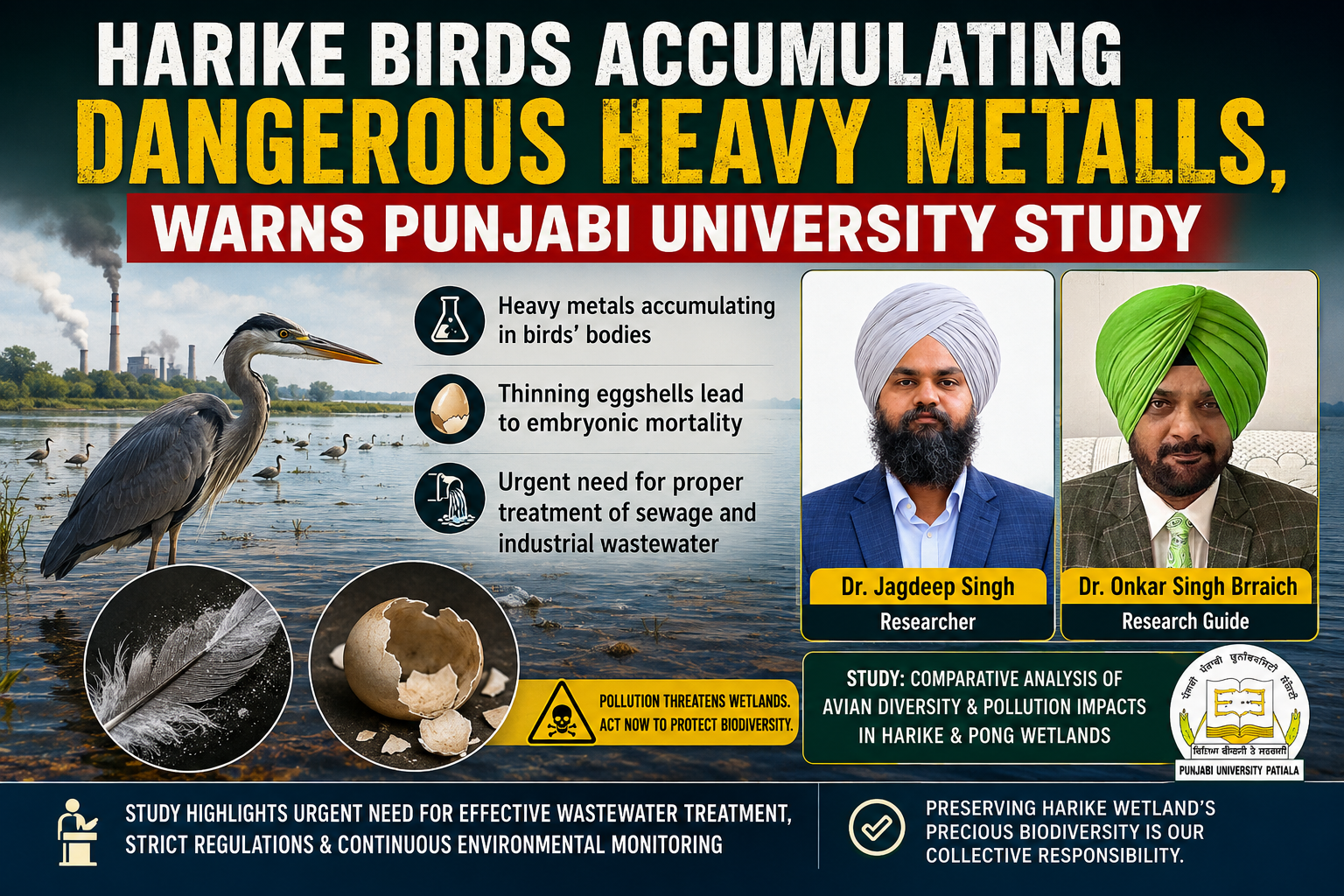

A research study conducted by Punjabi University has highlighted the growing environmental challenges facing Punjab’s wetlands, revealing that pollution and heavy metal contamination are posing a serious threat to bird populations, particularly at the Harike Wetland.
The comparative study on the avian diversity and pollution levels of Harike and Pong wetlands was carried out by researcher Dr. Jagdeep Singh under the guidance of Dr. Onkar Singh Brraich from the Department of Zoology and Environmental Sciences.
Dr. Jagdeep Singh said that Harike Wetland, a Ramsar site of international importance situated at the confluence of the Beas and Sutlej rivers, supports nearly 230 species of birds. However, untreated industrial and municipal wastewater discharged through Budha Nallah and Kala Sanghian Drain, along with agricultural runoff, has led to a sharp increase in heavy metal contamination. The study detected elevated levels of lead, cadmium, chromium, nickel, iron, copper, zinc and manganese in the wetland ecosystem.
To assess pollution without disturbing wildlife, researchers analysed naturally shed bird feathers and discarded eggshells, which served as non-invasive bio-indicators of environmental contamination.
According to Dr. Onkar Singh Brraich, the findings revealed that birds inhabiting Harike Wetland carried significantly higher concentrations of heavy metals than those at Pong Wetland. The contamination has resulted in thinner and more fragile eggshells, causing premature breakage and increased embryo mortality, a factor contributing to the decline in bird populations.
The researchers stressed that conserving Harike’s rich biodiversity requires scientific treatment of municipal sewage and industrial wastewater, strict enforcement of pollution-control regulations, and continuous environmental monitoring.
Punjabi University Vice-Chancellor Dr. Jagdeep Singh congratulated the researcher and his supervisor, describing the study as an important wake-up call for the conservation of wetlands and bird habitats. He said the findings provide valuable scientific evidence that can help policymakers formulate effective environmental protection strategies and strengthen biodiversity conservation efforts.