




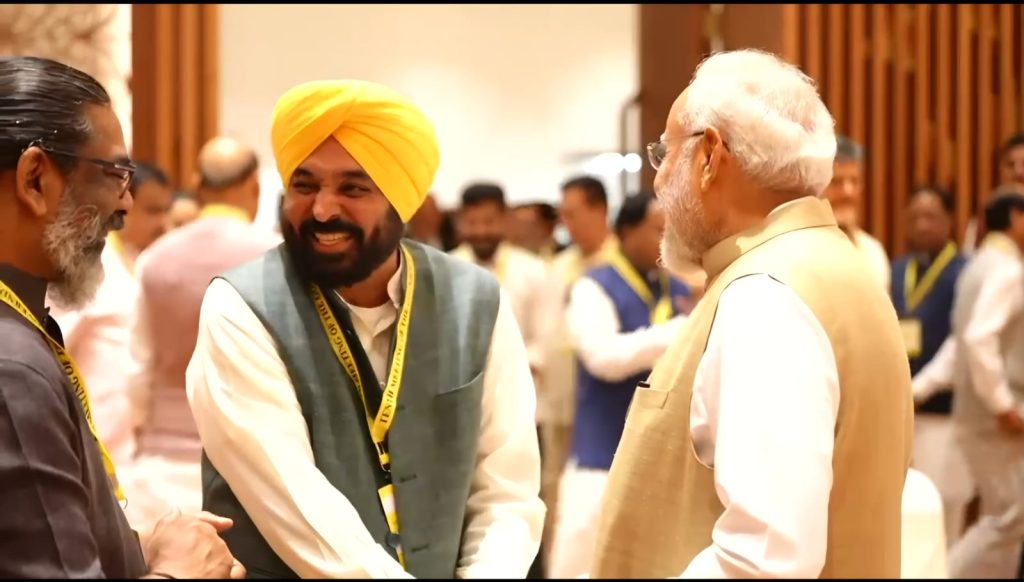
New Delhi, May 24,
During the 10th Governing Council meeting of NITI Aayog, Punjab Chief Minister Bhagwant Singh Mann strongly criticized the Union government’s discriminatory treatment of Punjab, raising critical issues concerning water rights, Bhakra Beas Management Board (BBMB), Chandigarh’s administration, and economic development. He urged for equitable policies, increased funding, and incentives to bolster Punjab’s growth and border security.
Key Issues Raised
- Water Rights and Yamuna-Sutlej-Link (YSL):
- Mann reiterated that Punjab has no surplus water to share, citing the deficit in Ravi, Beas, and Sutlej rivers. He proposed a Yamuna-Sutlej-Link (YSL) canal over the Satluj Yamuna Link (SYL), referencing a 1954 agreement entitling erstwhile Punjab to two-thirds of Yamuna waters.
- He highlighted the 1972 Irrigation Commission report classifying post-1966 Punjab as part of the Yamuna River Basin, arguing that Punjab deserves an equal claim to Yamuna waters if Haryana claims Ravi and Beas waters.
- Mann criticized the lack of storage structures on the Yamuna, leading to water wastage, and demanded Punjab’s inclusion in revising the water-sharing agreement.
- Bias in Bhakra Beas Management Board (BBMB):
- Mann accused BBMB, established under the Punjab Reorganization Act, 1966, of ignoring Punjab’s interests. Despite Punjab’s liberal water-sharing in the past, 76.1% of its 153 blocks are now over-exploited due to depleted groundwater.
- He criticized BBMB’s decision to release 8,500 cusecs of water to Haryana, despite Punjab’s objections and Haryana’s actual need of only 1,700 cusecs. Punjab released 4,000 cusecs on humanitarian grounds, but Mann called for BBMB to adhere to legal provisions and ensure financial efficiency.
- He raised concerns about the marginalization of Punjab officers in BBMB and urged a transparent, neutral approach.
- CISF Deployment at Bhakra Nangal Dam:
- Mann opposed the Ministry of Power’s decision to deploy CISF at Bhakra Nangal Dam, calling it unnecessary and an infringement on Punjab’s rights. He demanded its immediate revocation, noting that Punjab has managed the dam’s security effectively since its construction.
- Chandigarh Administration Representation:
- Mann demanded restoration of the 60:40 ratio for Punjab and Haryana officers in Chandigarh’s administration, a convention since 1966. He criticized the increasing centralization through AGMUT and DANICS cadre appointments, which sidelined Punjab officers, and called for repealing amendments allowing other states’ personnel to fill posts.
- Post-Matric Scholarship Arrears for SC Students:
- With Punjab having the highest Scheduled Caste population (31.94%), Mann sought the release of Rs 938.26 crore in arrears for the Post-Matric Scholarship Scheme (2017-20). He criticized the Centre’s 2018 criteria change, which increased Punjab’s liability from Rs 60.79 crore to Rs 800.31 crore, burdening the state unfairly.
- Desilting Harike Headworks:
- Mann highlighted the reduced capacity of the Harike Headworks reservoir due to sedimentation, affecting water supply to southwest Punjab, Rajasthan, and flood-prone areas up to Kapurthala. He requested Rs 600 crore for desilting, urging cost-sharing by the Centre and Rajasthan due to its Ramsar site status.
- Economic and Industrial Development:
- Mann sought a special industrial package for border districts (Amritsar, Gurdaspur, Tarn Taran, Ferozepur, Fazilka, Pathankot) to counter disadvantages from proximity to Pakistan, including PLI schemes, freight subsidies, tax relief, and agro-zones.
- He proposed an Economic Corridor along the Delhi-Katra Expressway, a Global Manufacturing Hub along the Bharat Mala corridor, and a Special Economic Zone (SEZ) to boost Punjab’s industrial ecosystem.
- Mann requested the extension of Software Technology Parks of India (STPI) in Mohali and sector-specific export zones in Jalandhar (sports goods), Amritsar (food processing), Ludhiana (textiles), and Mohali (automobile parks).
- He urged royalty-free coal supply from PSPCL’s Pachwara mine to IPPs supplying power to Punjab.
- Border Security and Infrastructure:
- Mann demanded Rs 2,829 crore to combat drug trafficking and enhance border security, including infrastructure upgrades, jail security, and de-addiction centers. He noted 53,000 arrests and 3,579 kg of heroin seized, requesting 50 additional jamming systems for the 553 km border.
- He sought infrastructure grants for border resilience, covering EOCs, trauma centers, bunkers, cybersecurity, and resilient infrastructure, as only 101 villages are under the Vibrant Village scheme.
- Mann requested increasing farmers’ compensation for land between the fence and border from Rs 10,000 to Rs 30,000 per acre/year and restoring the daily allowance for Border Wing Home Guards from Rs 45 to Rs 655.
- Crop Diversification and Agriculture:
- To address the agrarian crisis, Mann proposed a Rs 17,500 per hectare cash incentive for maize to replace paddy, approval for BT-III cotton, subsidies for mating disruption techniques, and support for agro-processing units.
- He sought increased NFSA allocation from 5kg to 7kg, expanded godown capacity, and expedited stock lifting. watch……ग्रामीण आबादी को 315 करोड़ की योजनाओं से मिलेगा पीने का साफ पानी
Punjab’s Vision for Viksit Bharat @2047
Mann reaffirmed Punjab’s alignment with Viksit Bharat, aiming for a vibrant, inclusive “Rangla Punjab” with 8%+ annual GDP growth through industrial and service-led development. Key initiatives include:
- Doorstep Delivery: 406 G2C services via helpline 1076, reducing corruption.
- Health Revolution: Over 3.34 crore patients served free through Aam Aadmi Clinics and Aayushman Arogya Kendras.
- Sadak Surakhiya Force: Launched in 2024 with 144 tech-enabled vehicles, reducing road fatalities by 10% and assisting 30,000+ road users.
- Punjab Sikhya Kranti: 118 Schools of Eminence, 437 Schools of Happiness, 40 Schools of Applied Learning, and teacher training in Singapore and Finland.
- Youth and Rural Development: Gyms and playgrounds in every village, 100% electrification and water supply in 12,581 villages, and world-class roads in major cities.
- Women’s Empowerment: 33% job reservation, 50% in local governance, 13 crore free bus rides, and Sakhi Centres supporting 20,000+ women.
- Industrial Growth: Strengthened Unified Regulator Model, expanded Right to Business Act, and a focus on manufacturing and services like IT, semiconductors, and defense.
Mann opposed unilateral borrowing limit deductions under Article 293, proposing a 50% vertical devolution and inclusion of cesses, surcharges, and non-tax revenue in the divisible pool.