



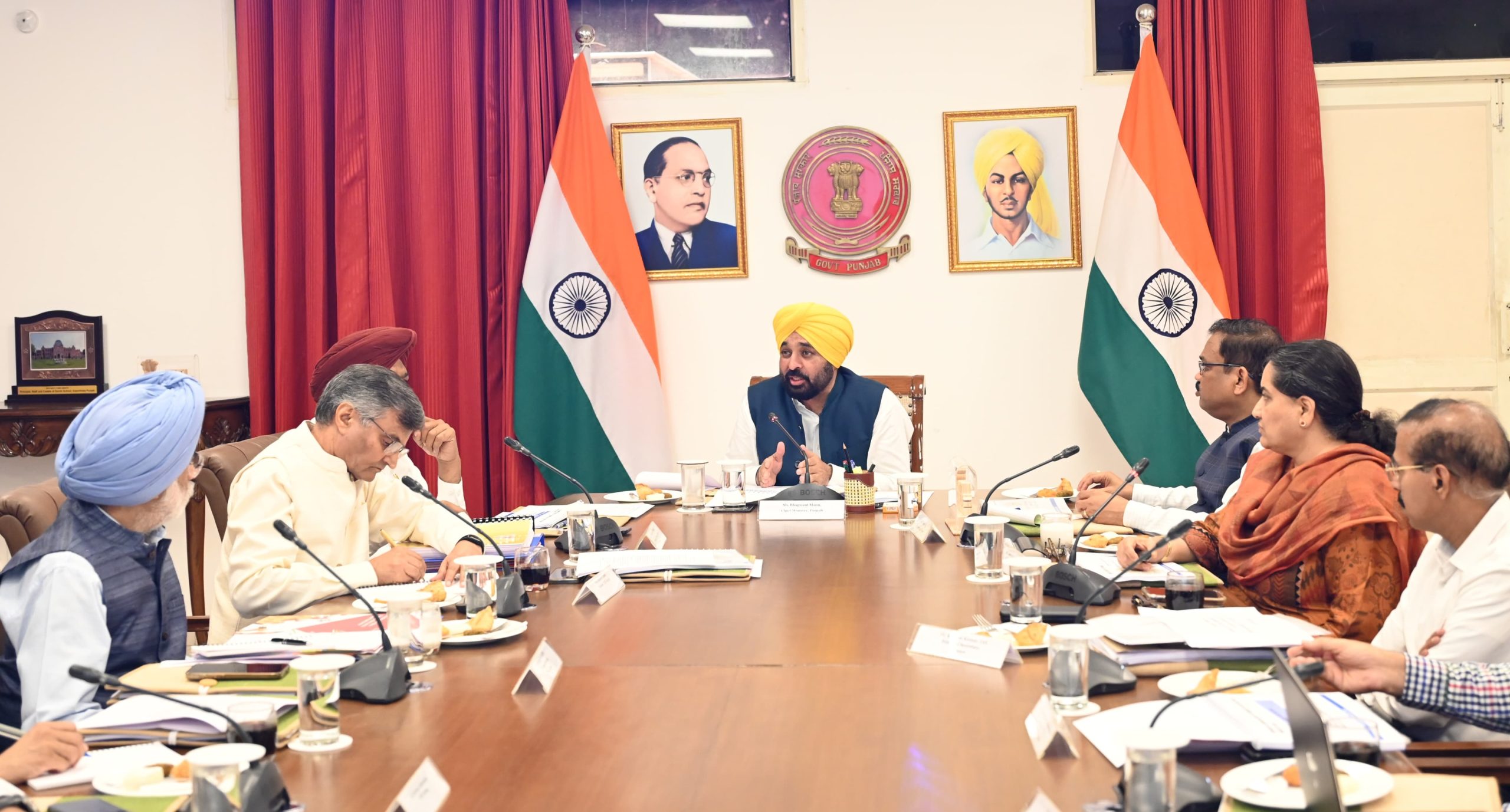

Chandigarh, July 7, 2025
In a landmark meeting chaired by Chief Minister Bhagwant Singh Mann, the Punjab Cabinet made several significant decisions, including withdrawing the Congress government’s 2021 decision to deploy the Central Industrial Security Force (CISF) at Bhakra Dam, approving 3,600 special educator teacher posts, and introducing measures to promote animal welfare, education, and taxation reforms.
Reversal of CISF Deployment at Bhakra Dam
The Cabinet rescinded the July 23, 2021, decision by the previous Congress government to deploy CISF at Bhakra Dam, labeling it an “anti-state” move that undermined the capable Punjab Police. A spokesperson from the Chief Minister’s Office stated that the Punjab Police’s proven track record in maintaining law and order negates the need for external forces. The Cabinet announced:
-
A resolution opposing CISF deployment will be tabled in the upcoming state assembly session.
-
The state will not fund CISF deployment, emphasizing Punjab Police’s ability to secure the dam.
-
The decision prioritizes state interests and reverses the Congress government’s stance, which was seen as a “humiliation” for Punjab.
watch…..CM Mann Unveils ₹350 Crore Development Bonanza for Amritsar Residents
Approval of Animal Welfare Legislation
The Cabinet approved the Punjab Prevention of Cruelty to Animals (Punjab Amendment) Act 2025 and the Punjab Prevention of Cruelty to Animals (Conduct of Bullock Cart Race) Rules, 2025. These measures aim to regulate animal sports, particularly bullock cart racing, a traditional rural sport in Punjab. Key objectives include:
-
Ensuring animal safety with veterinary supervision.
-
Establishing safety standards, registration, and penalties for violations.
-
Preserving indigenous cattle breeds and promoting traditional sports, including events like the Kila Raipur Rural Sports Event and Fair.
Creation of 3,600 Special Educator Teacher Posts
To support 47,979 children with special needs in government schools, the Cabinet approved 3,600 new posts for special educator teachers:
-
1,650 posts: Special Educator Teacher (Master Cadre)
-
1,950 posts: Special Educator Teacher (Primary Cadre) These positions, converted from vocational, art and craft, and ETT posts, will be filled over three years, enhancing inclusive education in Punjab.
Security of Tenure for 22 Employees
The Cabinet revisited a 2016 decision and granted tenure security to 22 employees at the Rural Institute for Vocational Training, Badal, against 37 permanent posts. This decision, aligned with advice from the Finance and Personnel Departments, resolves longstanding legal issues and secures the employees’ future.
Amendments to Punjab State Development Tax Act 2018
The Cabinet approved amendments to the Punjab State Development Tax Act 2018 to:
-
Define “salary” to broaden the tax base and ensure comprehensive coverage.
-
Introduce a lump-sum tax payment option of ₹2,200 for the full financial year (by April 30) as an alternative to the monthly ₹200 tax liability.
-
Establish a One-Time Settlement (OTS) mechanism by adding new sections to address tax liabilities in cases of death, company amalgamation, or liquidation. These changes aim to simplify tax compliance, boost collections, and improve efficiency.
Approval for Private Universities
To enhance access to quality higher education, the Cabinet approved the establishment of two self-financed private universities under the Punjab Private Universities Policy 2010:
-
CGC University Mohali at Jhanjeri, SAS Nagar Mohali.
-
Rayat Bahara Professional University in Hoshiarpur. These institutions are expected to drive educational excellence and catalyze regional development in Mohali and Hoshiarpur.
Significance
The Cabinet’s decisions reflect the Mann government’s commitment to prioritizing state autonomy, education, environmental and animal welfare, and fiscal efficiency. By reversing the CISF deployment, Punjab asserts the capability of its police force. The creation of special educator posts and new universities underscores a focus on inclusive and quality education, while legislative amendments promote traditional sports and tax compliance. These steps position Punjab as a progressive state dedicated to public welfare and sustainable development.